


Quick Answer
Merchant navy salary in India in 2026 typically starts at ₹25,000–₹85,000 per month for deck and engine cadets and can go up to ₹8 lakh–₹20 lakh per month for a Captain or Chief Engineer with extensive sea experience. Junior officers such as Third Officers and Fourth Engineers usually earn ₹1 lakh–₹2.5 lakh per month. Actual figures vary by shipping company, vessel type, flag state, and years of sea service, since this sector runs largely on private and international pay structures rather than a single government pay commission.
Quick Facts Table
| Rank/Level | Monthly Pay (Approx.) | Gross with Allowances/Perks | Sector Comparison | Experience Level |
|---|---|---|---|---|
| GP Rating / OS / Wiper | ₹25,000–₹60,000 | ₹30,000–₹75,000 | Mostly private/foreign employers | Entry-level (0–2 yrs) |
| Deck/Engine Cadet | ₹25,000–₹70,000 | ₹30,000–₹85,000 | Private companies dominate hiring | Entry-level (training phase) |
| 3rd Officer / 4th Engineer | ₹1,00,000–₹1,80,000 | ₹1.2 lakh–₹2 lakh | Foreign-flag ships pay 20–30% more | Junior officer (2–4 yrs) |
| 2nd Officer / 2nd Engineer | ₹1.8 lakh–₹3 lakh | ₹2 lakh–₹3.5 lakh | Higher on tankers/LNG carriers | Mid-level (5–8 yrs) |
| Chief Officer / Chief Engineer | ₹3 lakh–₹6 lakh | ₹3.5 lakh–₹7 lakh | Rare government-linked roles exist (SCI) | Senior (8–12 yrs) |
| Captain / Master | ₹5 lakh–₹20 lakh+ | ₹6 lakh–₹22 lakh | Private/foreign shipping pays premium | Top-level (12+ yrs) |
Figures are indicative industry estimates for 2026 and vary by employer; the merchant navy does not follow a uniform central pay commission scale like most government departments.
Official Pay Scale Breakdown
Unlike railway, banking, or defence jobs, merchant navy salary in India is not fixed by a single pay commission because the vast majority of Indian seafarers work for private Indian shipping companies or foreign-flagged vessels registered abroad. Pay is instead governed by individual company contracts, international maritime wage guidelines, and the type of vessel.
That said, a small number of seafarers work with government-linked entities such as the Shipping Corporation of India (SCI), where pay partially aligns with public sector undertaking (PSU) pay scales rather than the standard central pay commission structure used for civil services. Even there, officers usually receive a consolidated sea-going allowance package on top of basic pay, making actual take-home earnings significantly higher than the basic pay slip suggests.
For most cadets and officers, salary structure works like this: a fixed monthly wage for the duration of the sailing contract (usually 4–9 months), which already factors in overtime, leave pay, and a portion of allowances. This is different from a typical shore job where basic pay, DA, and HRA are itemised separately every month.
Merchant Navy Salary: Government vs Private Sector
- Government/PSU-linked (e.g., Shipping Corporation of India): More structured pay bands, defined increments, pension and gratuity benefits, but overall monthly cash salary is often lower than what top private and foreign companies pay at the same rank.
- Private Indian shipping companies: Competitive salaries, faster promotions based on merit and certification, but fewer long-term social security benefits compared to PSU roles.
- Foreign-flag/international companies: Typically pay 20–50% more than Indian companies for the same rank, especially on tankers, LNG carriers, and container ships. These roles are the most sought-after among Indian seafarers for this reason.
In short, government-linked merchant navy jobs offer stability, while private and foreign companies offer higher pay but with contract-based employment and no pension.
State-Wise Salary Variation
Merchant navy salary itself does not change by the state where a seafarer is posted, since salary is paid based on the ship and the hiring company, not a state government pay scale. However, the state a candidate is based in affects training costs, placement opportunities, and access to top maritime companies. Here is how this plays out across major states:
- Maharashtra: Home to Mumbai, the hub of most Indian shipping companies and manning agents. Candidates trained or based here often get faster placement and marginally better starting offers due to direct company access.
- Kerala: A major source state for Indian seafarers, especially ratings and engine crew, with several respected maritime training institutes; salary offers are on par with national averages.
- Tamil Nadu: Strong presence of maritime academies (including government-recognised ones); graduates here regularly get placed with mid-size and large shipping companies at standard industry pay.
- Uttar Pradesh: A growing source state for merchant navy aspirants, particularly for GP Rating and cadet courses; salary during training is same as elsewhere, but travel to Mumbai/Chennai for interviews and joining is a common added cost.
- Gujarat: With major ports like Kandla and Mundra, some shore-adjacent shipping and logistics roles pay competitively, though pure sailing salaries follow the same national pay bands as other states.
The real driver of pay difference is not the state but which company and vessel type a candidate joins.
Allowances Explained
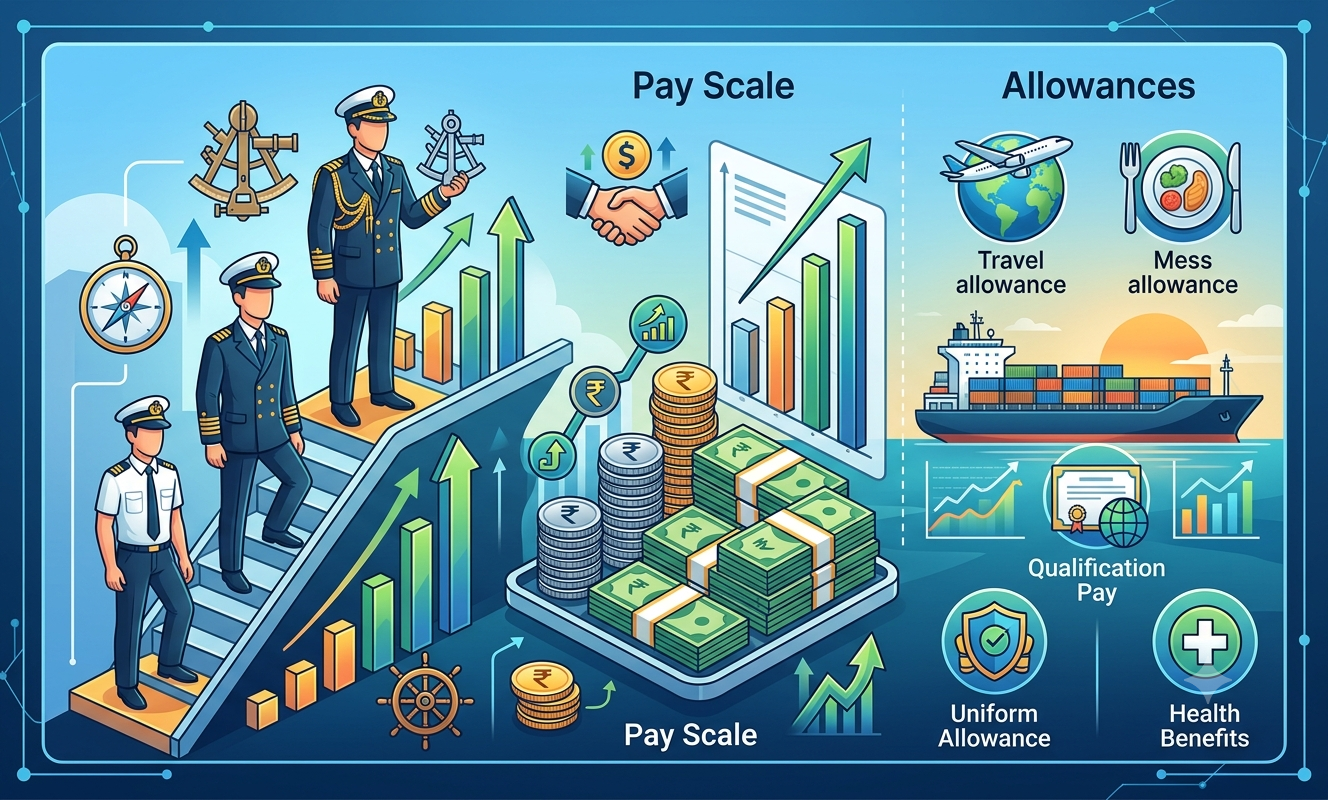
Merchant navy pay packages typically bundle allowances into the total monthly salary rather than listing them separately like a government payslip. Common components include:
- Sailing/Sea Allowance: Paid for every day spent on board; often the single largest component pushing gross pay well above basic pay.
- Overtime (OT): Contracted rate per hour beyond standard duty hours, common on cargo and tanker vessels with heavy operational schedules.
- Leave Pay: Compensation accrued for the days a seafarer is on paid leave between contracts.
- Risk/Hardship Allowance: Extra pay for specific high-risk routes (piracy-prone waters) or hazardous cargo like chemicals and LNG.
- Provident Fund & Gratuity: Offered by most reputed Indian companies, deducted and contributed similarly to shore-based PF rules.
- Food & Accommodation: Provided free on board, effectively increasing the real value of take-home salary since living costs at sea are covered by the employer.
- Medical & Insurance Cover: Mandatory under international maritime labour conventions, adding non-cash value to the overall package.
Because food, stay, and travel to the ship are employer-borne, the effective value of a merchant navy salary is generally higher than the same cash figure earned in a shore job.
Career Growth Path and Salary Progression
Salary in the merchant navy grows steadily with sea time, certification exams (Certificate of Competency levels), and rank promotions:
- Cadet (0–1 year): ₹25,000–₹70,000/month during training and first contract.
- Junior Officer — 3rd Officer/4th Engineer (1–4 years): ₹1 lakh–₹1.8 lakh/month after clearing the relevant competency certificate.
- 2nd Officer/2nd Engineer (4–8 years): ₹1.8 lakh–₹3 lakh/month, taking on more watchkeeping and technical responsibility.
- Chief Officer/Chief Engineer (8–12 years): ₹3 lakh–₹6 lakh/month, second-in-command on the vessel.
- Captain/Master (12+ years): ₹5 lakh–₹20 lakh+/month, full command responsibility, highest earning tier in the industry.
Each promotion requires passing mandatory Directorate General of Shipping (DGS) competency examinations along with the required sea service, so salary growth is directly tied to qualifications, not just years worked.
Eligibility, Qualifications and Starting Salary
Entry route significantly affects starting merchant navy salary:
- After 10th standard: Eligible only for GP Rating courses, leading to entry-level crew roles with lower starting pay (₹25,000–₹60,000/month).
- After 12th (Science stream, PCM): Eligible for Deck Cadet, Engine Cadet (via B.Sc Nautical Science or Marine Engineering diploma/degree), and ETO Cadet routes, generally starting at ₹30,000–₹70,000/month with faster promotion tracks.
- After graduation (B.Tech/B.E or B.Sc): Can enter directly into cadet training with a slightly better starting offer at top companies, especially with a marine engineering or nautical science degree.
- Additional certifications: STCW (Standards of Training, Certification and Watchkeeping) courses and DGS-approved competency certificates are mandatory at each promotion stage and directly unlock the next salary bracket.
Higher entry qualifications generally mean a shorter path to officer rank and, therefore, faster salary growth.
In-Hand Salary vs CTC/Gross Salary
Merchant navy pay is usually quoted as a flat monthly figure rather than a CTC breakup, but it’s still useful to separate what’s “in-hand” from what’s part of the total package:
- Gross/Contract Salary: The full monthly figure mentioned in the employment contract, inclusive of sea allowance, overtime, and leave pay.
- In-Hand/Take-Home: Gross salary minus PF contribution (where applicable) and any advance/loan deductions; usually 85–95% of gross since income tax rules for seafarers (NRI-linked tax benefits based on days spent outside India) often reduce or eliminate tax liability.
- Non-Cash Benefits: Free food, accommodation, medical cover, and travel to/from the vessel are not included in the salary figure but add real value, often equivalent to an additional ₹15,000–₹40,000/month if paid for independently.
Most seafarers who meet the required number of days outside India in a financial year qualify as Non-Resident Indians (NRI) for tax purposes, which is one of the biggest practical advantages of a merchant navy salary compared to an equivalent shore-based income.
Merchant Navy Salary vs Related Roles Comparison
| Role | Entry-Level Monthly Pay | Senior-Level Monthly Pay | Job Stability |
|---|---|---|---|
| Merchant Navy Officer | ₹30,000–₹70,000 | ₹5 lakh–₹20 lakh+ | Contract-based, high pay ceiling |
| Indian Navy Officer (Defence) | ₹56,100–₹1,77,500 (pay level, govt scale) | Up to ₹2,25,000 (pay level, plus MSP & allowances) | Permanent, pensionable |
| Port/Shipping Authority Shore Staff | ₹35,000–₹60,000 | ₹1.5 lakh–₹2.5 lakh | Permanent, stable but lower ceiling |
Indian Navy figures follow the 7th Central Pay Commission pay matrix and are not comparable one-to-one with merchant navy’s contract-based pay, but are included here since aspirants frequently compare the two career paths.
Frequently Asked Questions
1. What is the minimum salary in merchant navy? The minimum starting salary is around ₹25,000 per month, typically for GP Rating or entry-level cadet positions right after joining.
2. What is the maximum salary in merchant navy? Senior Captains and Chief Engineers on premium vessels like LNG carriers or large tankers can earn ₹15 lakh to ₹20 lakh or more per month at the peak of their career.
3. What is the merchant navy salary after 5 years of experience? After around 5 years, most officers reach the 2nd Officer or 2nd Engineer rank, earning approximately ₹1.8 lakh to ₹3 lakh per month, depending on the company and vessel type.
4. What is the merchant navy salary after 10 years of experience? By 10 years, many officers reach Chief Officer or Chief Engineer rank, with monthly pay typically in the ₹3 lakh to ₹6 lakh range.
5. What is the merchant navy salary in Maharashtra? Salary does not officially vary by state, but Maharashtra-based candidates, especially those trained or placed through Mumbai-based companies, often get faster access to higher-paying international shipping contracts.
6. How does salary hike work in merchant navy? Salary increases mainly through rank promotion after clearing DGS competency exams, gaining additional sea time, and moving to higher-paying vessel types or foreign-flag companies rather than through annual increments like a typical shore job.
7. What is the difference between government and private merchant navy salary? Government-linked roles (like those with Shipping Corporation of India) offer more stability, pension, and structured pay bands, while private and foreign shipping companies generally pay 20-50% more but on a contract basis without long-term social security.
8. What is the starting salary for freshers in merchant navy? Freshers joining as deck or engine cadets typically start at ₹25,000 to ₹70,000 per month, with the exact figure depending on the hiring company, course completed, and type of vessel assigned.
9. Does merchant navy salary include free food and accommodation? Yes, food, accommodation, and medical cover on board are provided free by the employer during the sailing contract, in addition to the monthly cash salary.
10. Is merchant navy salary tax-free in India? Not entirely tax-free, but many seafarers qualify for NRI tax status if they spend the required number of days outside India in a financial year, which can significantly reduce or remove income tax liability on their merchant navy salary.
Read More About – Loco Pilot Salary in India 2026: Full Pay Scale, Allowances & Growth

1 Comment
Pingback: NABARD Grade A Salary in India 2026: Full Pay Scale, Allowances & Growth - Salary Info Blog